What’s in the Data? (5/6)
Occupational Distribution of Job Postings
Marissa Hashizume, NLx Research Hub Economist
May 6, 2026

Welcome to the blog series, What’s in the Data? These posts will provide updates on available features and interesting discoveries in the NLx Research Hub data. Whether you’re an analyst or researcher, or just curious about what job posting data looks like, this series will keep you informed. We encourage those interested in using the NLx Research Hub data to check out our data request page for more information.
We often think of job postings as an approximation of job openings, or even hiring, but how good of an approximation are they really? We recently released a report analyzing the occupational makeup of our job posting data compared to job change data from the Current Population Survey (CPS). By comparing the two, we hoped to get a better sense of where job postings might be similar or different to hiring and provide some additional guidance to NLx Research Hub data users on considerations for using the NLx job posting data.
We found that most occupation groups make up similar portions of job postings and job changes, which is good news because it indicates that actual hiring is well represented across different occupations in the NLx data. The Sankey chart below shows the proportions of each occupation group for job postings (on the left side) and job changes (on the right side). Similar proportions are seen in the flatter or more horizontal lines. However, there are a few exceptions, seen in the large swoops from one side to the other.
The Largest Difference Between Job Postings and Job Changes Was in Health Practitioner and Technical Occupations
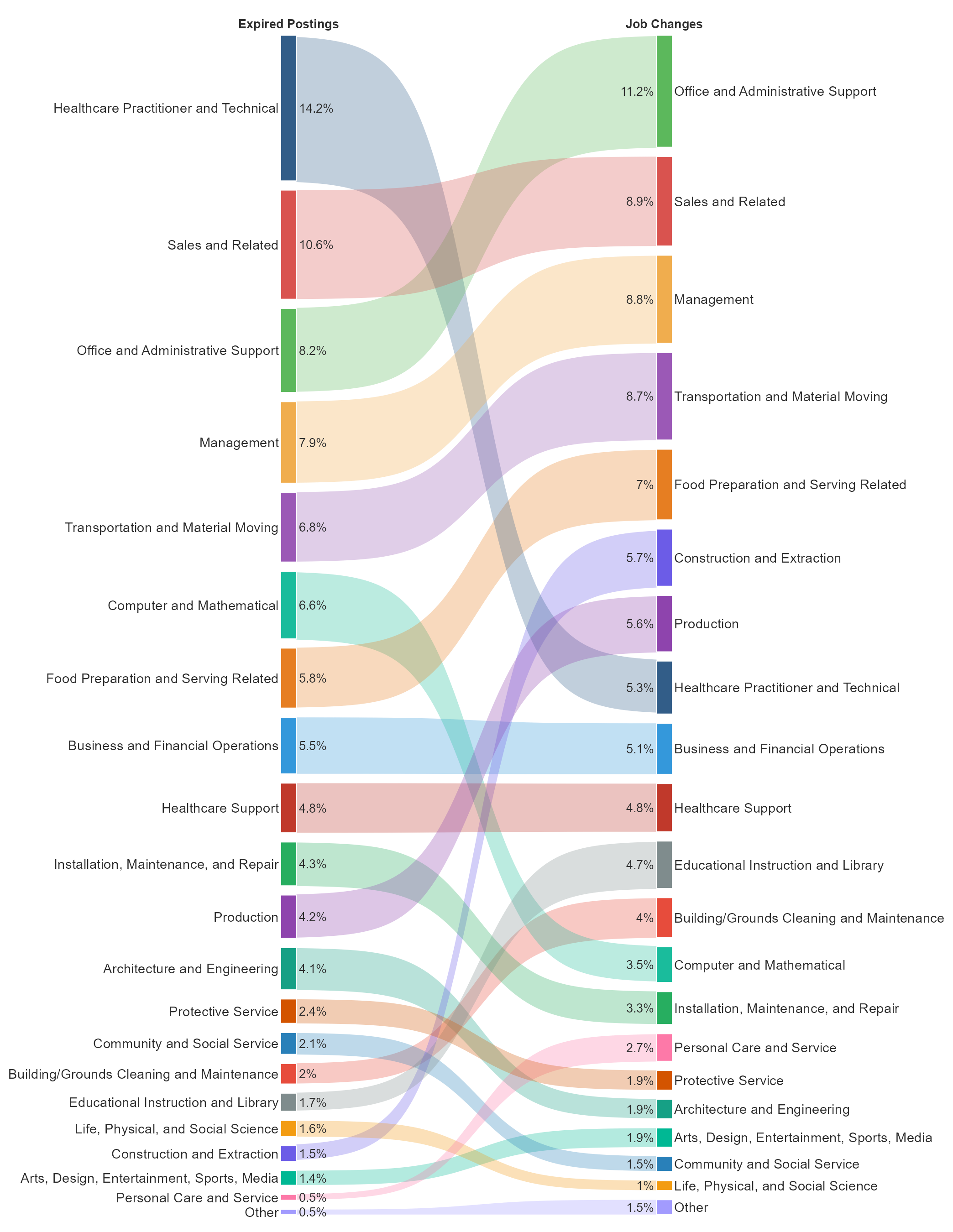
NLx Research Hub and CPS data
The “Other” category contains Legal; Farming, Fishing, and Forestry; and Military occupations, which each make up less than 1% of both job postings and job changes.
Percentages are the median across all months of 2025, so they won’t exactly sum to 100% but are close. CPS data is missing for October 2025 due to the government shutdown.
When we do see larger differences between job postings and job changes, the question then becomes why. Where are those differences coming from? Are they due to a conceptual difference between job postings and job changes? Are they due to NLx job postings (or online job postings more generally) being more likely to cover openings from some occupations than others?
Here is a summary of the largest two differences between the occupational makeup of job postings and job changes. More discussion on these and other occupation groups can be found in the full report.
The largest downward swoop in the Sankey chart is for Healthcare Practitioner and Technical occupations, which means those job changes are most overrepresented in NLx job postings (5% of job changes vs 14% of job postings). The most likely explanation for the overrepresentation of Healthcare Practitioner and Technical occupations in NLx job postings is a bias in the job posting data (i.e., NLx is more likely to capture job openings in this occupation group than others). That’s because we see no evidence of long posting times (potentially indicating openings that don’t end up as hires) and there is no conceptual reason to think that such a large portion of job postings aren’t reflected as traditional hires.
The largest upward swoop is for Construction and Extraction occupations, which means those job changes are most underrepresented in NLx job postings (6% of job changes vs 2% of job postings). One possible explanation for this is that these types of jobs might be more likely to be shorter-term or contact assignments. Those are less likely to show up as formal job postings prior to the “hire” we see in the CPS job change data. More generally, if openings are less likely to be posted online (regardless of reason), then we are more likely to see an underrepresentation in the NLx data.
Other explanations we discuss in the full report that might fully or partially clarify differences for these and other occupation groups include remote or multiple-location availability (“shadow” postings), seasonal hiring, gig work, and evergreen postings. If you’re interested in reading more about these other possible rationales, or learning more about our methodology, we encourage you to read the full technical report.